What was on Nashville’s hot list this weekend? The Iroquois Steeplechase. It’s been a Nashville spring tradition since 1941.
As one of the premier steeplechasing events in the country, the Iroquois offers the well-heeled social and equestrian circles of Nashville an opportunity to sport new spring fashions, party, and raise money for Monroe Carell Jr. Children’s Hospital at Vanderbilt. It’s a fun place to hang out for the day, especially if you’re a photographer.
So what did I see and photograph Saturday? Well, for starters, hats. Lots and lots of hats. Here’s a sampling:
This slideshow requires JavaScript.
Then, there’s the people watching. Let’s just say there were many fashion conscious people out there:
This slideshow requires JavaScript.
Some things I found humorous:
This slideshow requires JavaScript.
Some images seemed timeless:
This slideshow requires JavaScript.
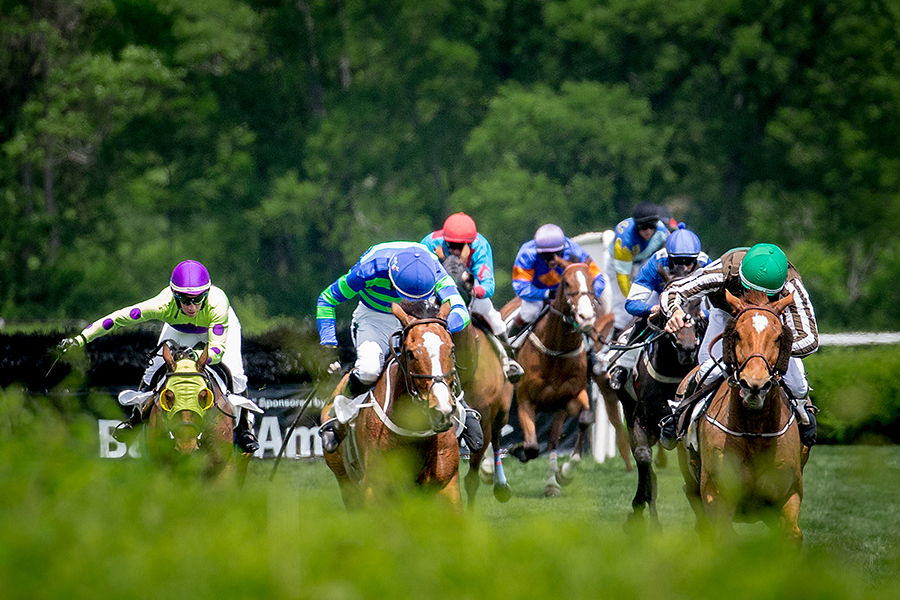
And last but not least, there’s the horses, the races, the jockeys, and the winners:
This slideshow requires JavaScript.
All in all, a great day. Thanks, as always, for following my blog.
a big wide world with people coming and going and sharing different viewpoints and perspectives as captured on my cell phone
We all see life and life’s events unfold through a lens that’s unique to our own lives. It’s a lens that’s based on where we’ve lived, our past experiences, those with whom we interact, books we read, jobs we hold, faiths we practice, places we have traveled, etc. It’s a big wide world out there with many different angles, viewpoints and perspectives.
So maybe it’s not such a stretch to suggest that media organizations also see through a filtered lens or subscribe to particular viewpoints. I know traditionally trained journalists pride themselves on unbiased, objective reporting, yet it seems more and more the daily news (or at least the news that’s emphasized) varies significantly from one media source to another.
In the early days of cell phone cameras, I remember reading FB posts from some photojournalists saying how disappointing it would be if the major news organizations started relying on amateur photos and video from cell phone cameras instead of their own professional equipment and training. I’m not sure what these photojournalists would say today, but I do think American journalism is struggling, and cameras on cell phones have little to do with it. I think many Americans today first learn of news from questionable or unreliable sources.
But recently during this period of evolving journalism came one very loud and clear news story: a troubled teen armed with semi-automatic weapons killed 17 and injured many more at a Parkland, Florida high school. And how did this news first break? Through student cell phones, which included still and video camera footage. You know what? That camera footage didn’t present the situation with a slanted, biased, or unvetted viewpoint; it presented the situation just as it played out.
There’s a lot of talk about the harmful effects of too much cell phone usage and with much of that I agree; it’s just that at the same time, I think it’s possible that that “transparency” so often promised but unfulfilled by politicians, is also lacking in many of the current media outlets. You know where you can find transparency? In the stills and video on your phone.
I’ve thought about posting some of the Parkland students’ videos herebut have decided they might be too disturbing for my audience so I’m now turning to discuss another form of camera phone transparency. Please keep reading – I’m building to a point here.
A couple months ago a friend invited me to join her at a http://www.Photovoice.org workshop in London. Rather than paraphrasing what Photovoice is all about, here are some quotes from its website:
Photovoice’s vision is for a world in which everybody has the opportunity to represent themselves and tell their own story. We work across the world to build skills in underrepresented communities, using participatory photography and digital storytelling methods. We have worked in partnership in over thirty five countries in seventy-three different projects. Photography for social change.
A caveat at this point – Photovoice projects sometimes use DSLRs or point and shoot cameras, but nevertheless often rely on the simplest and most available cameras, which often are cell phone cameras.
In trying to gain a better understanding of Photovoice, I began reading some of the posts from those who have already put cameras in the hands of the marginalized. The posts which can be found on the website are powerful.
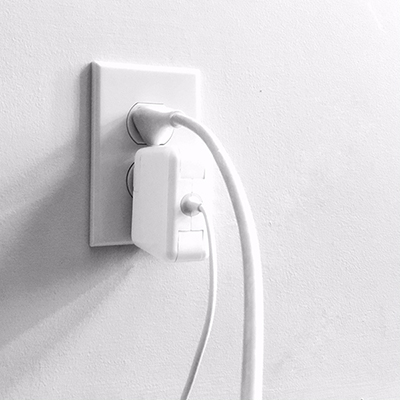
In one titled “Look Beyond – using Photovoice to break down barriers in mental health,” Dr. Maria Quinlan, a sociologist at the University College Dublin, asked a small group of students facing mental health challenges to tell their story – how they experienced life – by photographing their world. One student photographed an electrical socket with a cord plugged in on one side with the other side empty. His caption read: “Two sockets. One is connected, one disconnected. I have days when I’m connected to society and others where I’m totally detached. Lost, alone. I fight to stay connected, I want to, now stay connected. That is why the connected plug is first. This was not always the way.”
So what’s the point in all this?The point is that in an age when almost everyone carries a camera with them at all times, there is a greater transparency of what goes on in our world. So while politicians and perhaps the media often fall short on transparency, the news is there, often on our camera rolls. This constantly growing population of cell phone photographers supply us with the footage from school shootings, other people’s thought processes, and worlds we have never seen or experienced before.
Do I miss the days of the Walter Cronkite type journalism I felt I could trust? Yes. Do I miss mornings where I would search through TheTennessean newspaper for amazing photographs from veteran photojournalists? Absolutely. But am I also glad we now have an opportunity to see a broader, more transparent, more immediate view of the world as captured by a larger group of photographers? Yes.
I am glad both to have lived during the days when people read newspapers and watched the evening news, and to live today where so many have a camera in hand and capture a reality we otherwise might never have seen or understood. Cameras in the hands of just about everyone, not just a privileged few, provide an educational opportunity for us to discover worlds not previously seen or understood, and to act when we discover those in need or suffering injustice.
Thanks, as always, for following my blog. I won’t be attending a Photovoice workshop this spring, but I will be making an exciting announcement in the near future. I hope you’ll plug in.
When working in downtown Atlanta, my friends and I would sometimes walk down Marietta Street to the “Jesus Bakery” to buy a cake or a pie or some other sinful dessert for a co-worker’s birthday or because we just wanted to. These bakery goods were the real deal, made from real butter and sugar, all the good stuff, no preservatives.
The bakery actually had another name, we just called it the “Jesus Bakery” because of the inescapable message you received when there. So, for example, if visiting to ask if they could have a red velvet cake ready for pick-up the next day, the answer would always be “if the good Lord is willing.” More than once I left the store with more than I went in to buy. You might think that’s typical of a lot of shopping trips except I didn’t ask for or buy these extra pies or cakes, they just freely gave them to me.
Recently I’ve spent a lot of time driving with my husband through the South: 20 hours to and from Tampa a couple weekends ago with furniture to set up Scott’s new apartment, and 12 hours last weekend to and from South Carolina for Parents’ Weekend at our daughter’s college. These were in no way photography trips. It was mostly a lot of boring interstate with a day wedged in between when we could spend time with our children.
But I always bring a camera and so I took this image of Spanish moss at a rest stop somewhere in northern Florida.
Spanish moss hanging from a tree in northern Florida
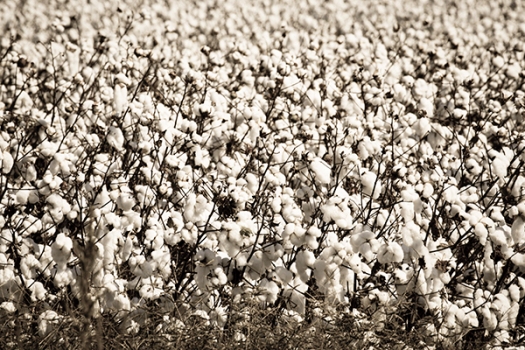
In South Georgia I was struck by the thick white cotton fields alongside the interstate. Don kindly exited the interstate and took a nearby frontage road so I could briefly photograph them.
irrigation system over Georgia cotton fieldsbig white fluffy cotton ready to pick in South Georgia cotton field
I say briefly not because Don or I were in any hurry, but because within a minute I realized I was standing in ankle high ant beds with armies of red fiery ants crawling all over and in my sandals. If you think there’s a lot of cotton in that field, I’m thinking there’s at least ten times as many ants.
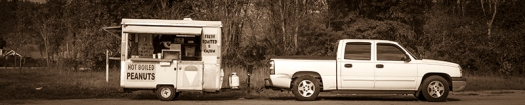
In South Carolina a week later, Don and Betsy gave me five minutes (bless their hearts) to take a couple photos of the boiled peanuts vendor who is always parked across the street from the local Walmart.
Hot boiled peanuts vendor parked outside a Walmart in Greenville, South Carolina
Twenty minutes later, I returned to the car having eaten and learned all about boiled peanuts and then giving Don a bag of roasted peanuts instead. And people wonder why I frequently run late …
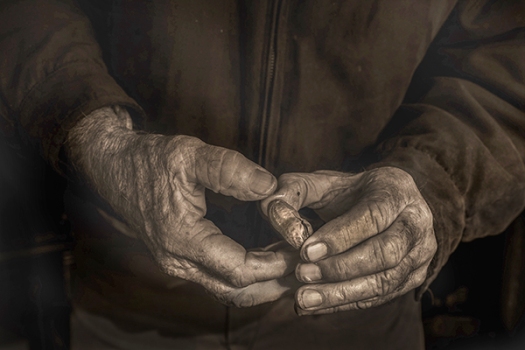
Here’s the peanut man getting ready to show me how to open a freshly boiled peanut:
How many peanuts have these hands opened?
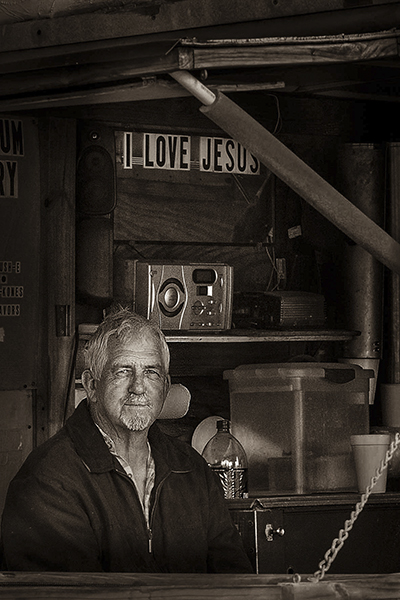
Here he is inside his trailer posing. Notice the sign above his radio.
peanut salesman posing in his trailer in Greenville, South Carolina
It’s occurred to me that the South is, in a sense, one big Jesus bakery. You enter it knowing you’ll be greeted by characters you just don’t meet anywhere else and you leave often taking home with you more than you bargained for. Yes, the Bible Belt is changing, but that’s why the real deal needs preserving through photographs.
Photographing the South is hardly an original idea; indeed, there are entire festivals and magazines devoted exclusively to southern photography, but I think, this Mississippi bred girl is going to take it on, slowly (as in years) but surely, if … the good Lord is willing. The landscape is beautiful, the people colorful, the culture intriguing, and … it’s home.
“One place understood helps us understand all places better.”
– Eudora Welty
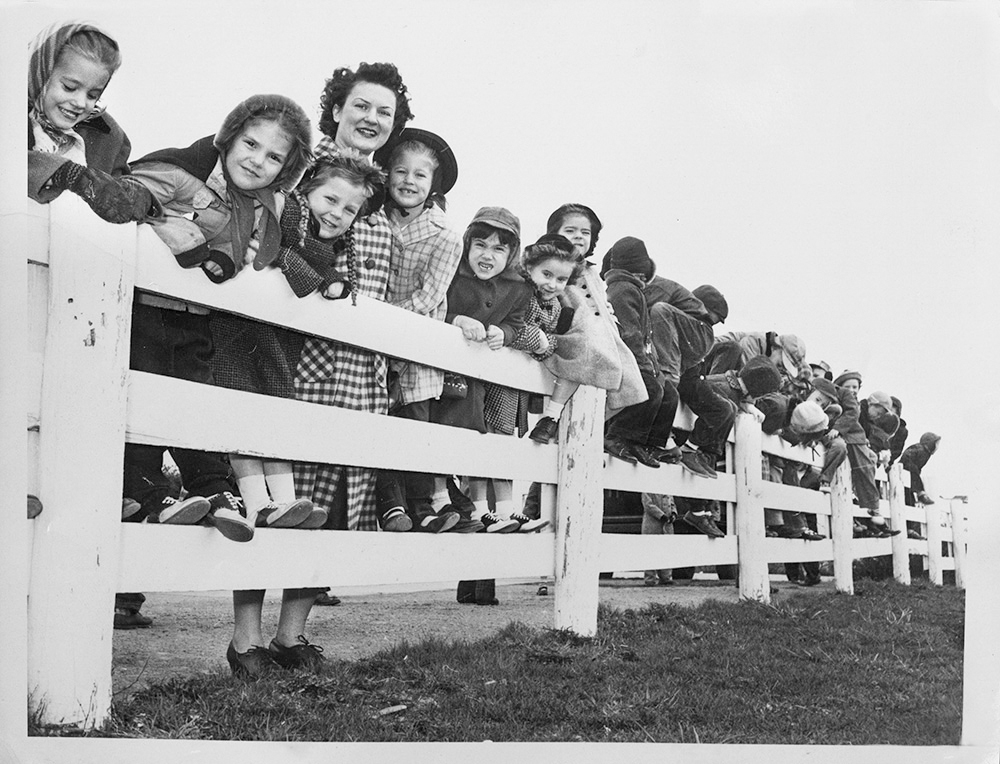
It was taken in March, 1953. The teacher had taken her class of kindergarten students to Kentucky’s Blue Grass Airport to watch the airplanes fly in and out. A photojournalist with the Lexington Herald took this picture as a feature for the newspaper.
Why is it one of my favorites? Because the teacher is my mother and it’s a great environmental portrait. My mother always loved children. Even when elderly and dementia prevented her from remembering familiar names or events, it was really not too surprising to walk into her room and find her singing or reciting a nursery rhyme to one or both of her very young great grandsons. So I like this photograph because Mom is surrounded by children and looking happy. It’s how I remember her looking at me as a child. And I think the photographer achieved what all great portrait photographers strive to achieve. He captured the essence or soul of his subject at that moment. For me, that renders this otherwise 1950’s era photograph timeless.
What else do I like about it? I like the leading lines of the fence and the kids hanging all over it. I like that the girls are closest to the teacher and smiling for the camera while the boys, for the most part, are climbing every which way at the end of the fence and just being boys. They’re a mess. I like the expressions on the girls’ faces and especially the shy grin on the girl closest to the camera. I like all the coats, hats, bobby socks, Oxford shoes and even my Mom’s shoes. I especially like that Mom is the only one pictured who is not wearing a hat, cap or scarf and her hair seems to be blowing freely in the wind. To me that’s symbolic of the relative freedom in her life at that time. Eight months later she would marry my dad and become a preacher’s wife. While many good things came of that, I think it’s fair to say her hair never blew quite as freely again.
Mom died in November 2014, but I still think of her often and always on August 10th. Today would be her 95th birthday. Yes, 95th. She was a little ahead of the curve in having a career first and then getting married and having children later in life. She was years ahead of Sheryl Sandberg who penned the bestseller Lean In. Look back at the photograph again. Mom is “leaning in.”
So … recently when attending a neighborhood happy hour social a new neighbor innocently asked, “What is your favorite photograph you’ve taken?” His question caught me off guard and all of a sudden I had that sinking feeling you get when you’re interviewing for a job and the interviewer asks you a wide open question just to see how you respond. It’s the “what’s your favorite book” question. After thinking about my neighbor’s question for a minute, I answered, “I really can’t say there’s one photograph I’ve taken that I like more than all the rest. Usually I have a group of favorites from each shoot, but there’s not one over-arching photograph I like better than all the rest.” He seemed disappointed and we moved on to other subjects.
I’ve been thinking about my neighbor’s question and my response from time to time since. In hindsight, I should have added, “but while I don’t have an all-time favorite photograph I’ve taken, I do have some favorite photographs – some I have taken and some others have taken. One of my favorite photographs is of my mother who I loved very much. One day in March 1953, a photojournalist I will never know took her picture …”
Do you have a favorite photograph? I ask only because I’ve learned it’s worth taking a little time to think about.






 Mary Rice's blog