Welcome back and apologies for the interruption in service. Seems like those pesky supply chain problems affect everything.
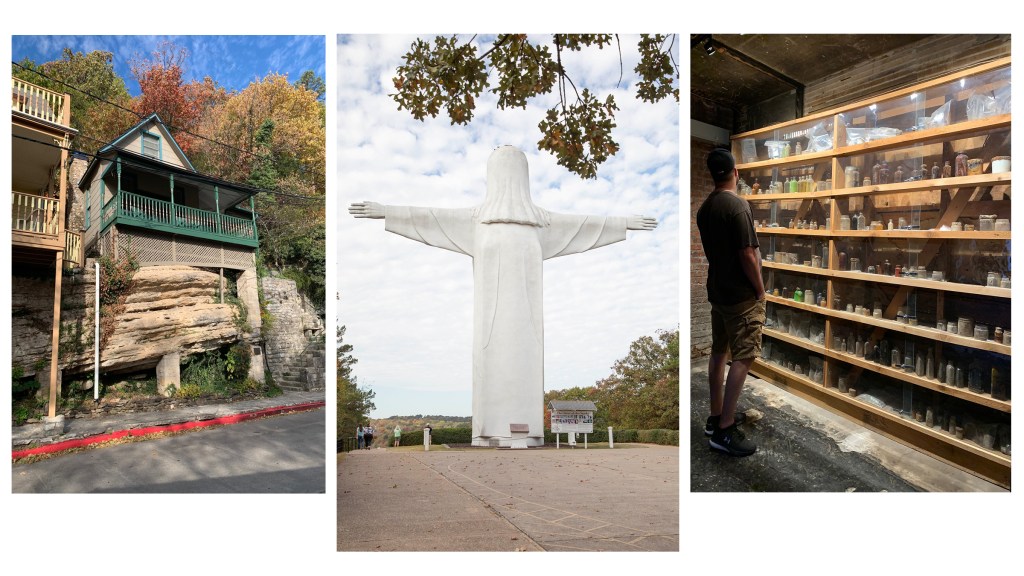
Anyway, I’m back to share some photographs I made on a recent trip to the quirky little town of Eureka Springs, Arkansas, home to the most haunted hotel in the US, many interesting engineering and architectural feats, a thriving artist community, and the seven story Christ of the Ozarks statue.
pictured left: home on a rock; pictured center: Jesus with a hump back; pictured right: man viewing specimens of real (but not live) human body parts in the basement/morgue of my hotel.
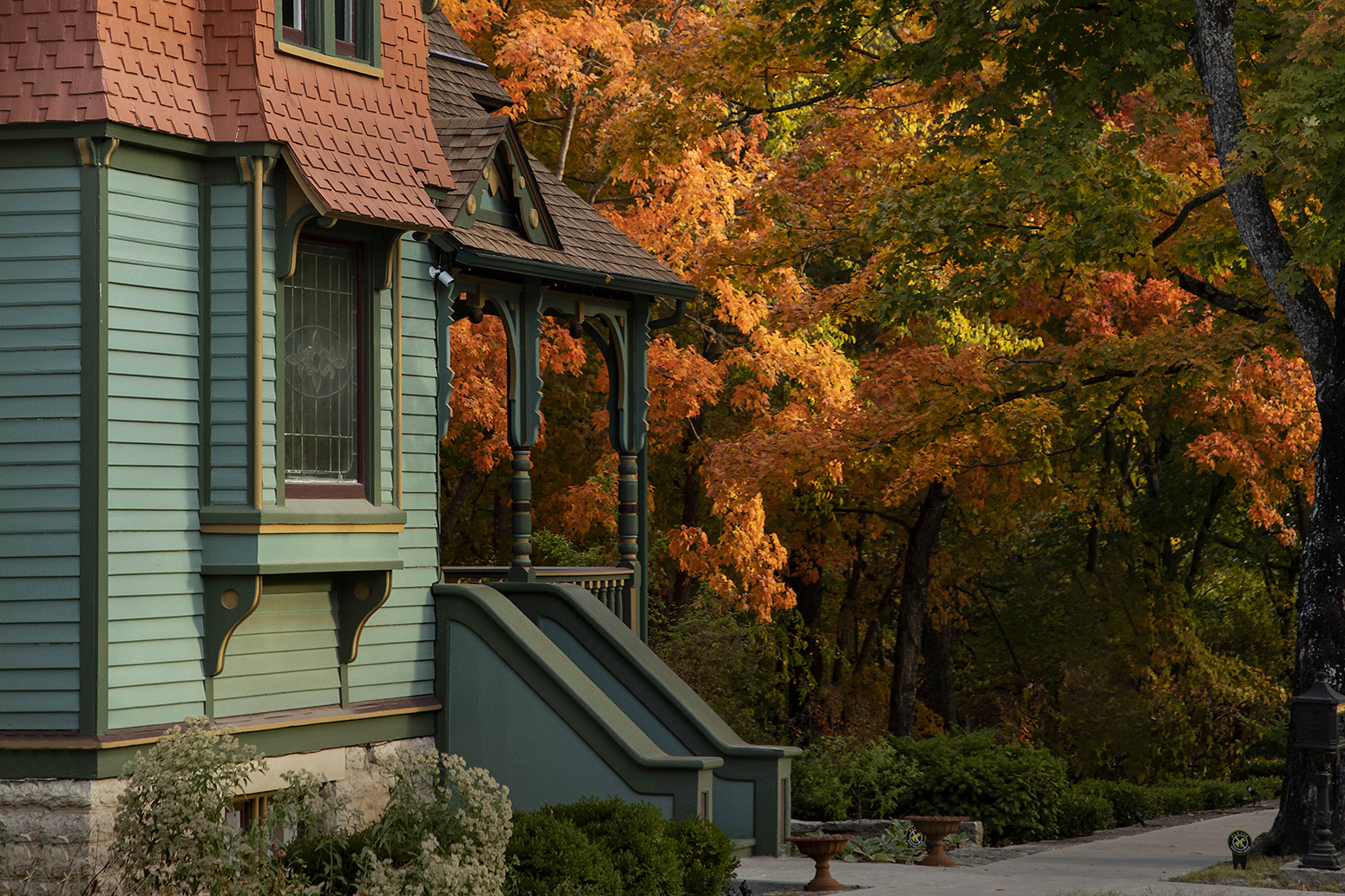
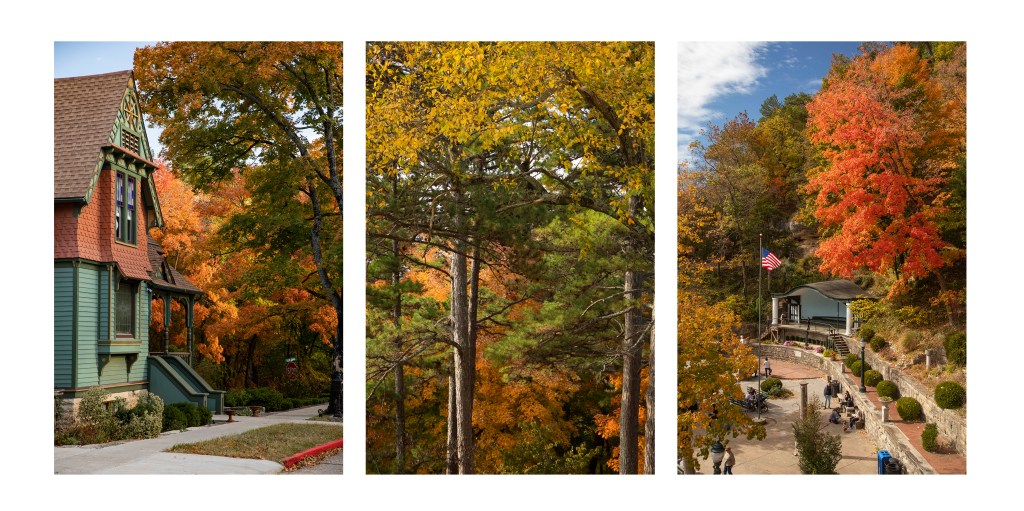
But aside from these curious sightings I also found the real reason for the trip – beautiful fall color.
fall color Eureka Springs, Arkansas
As an added bonus, I also discovered some classic black and white images.
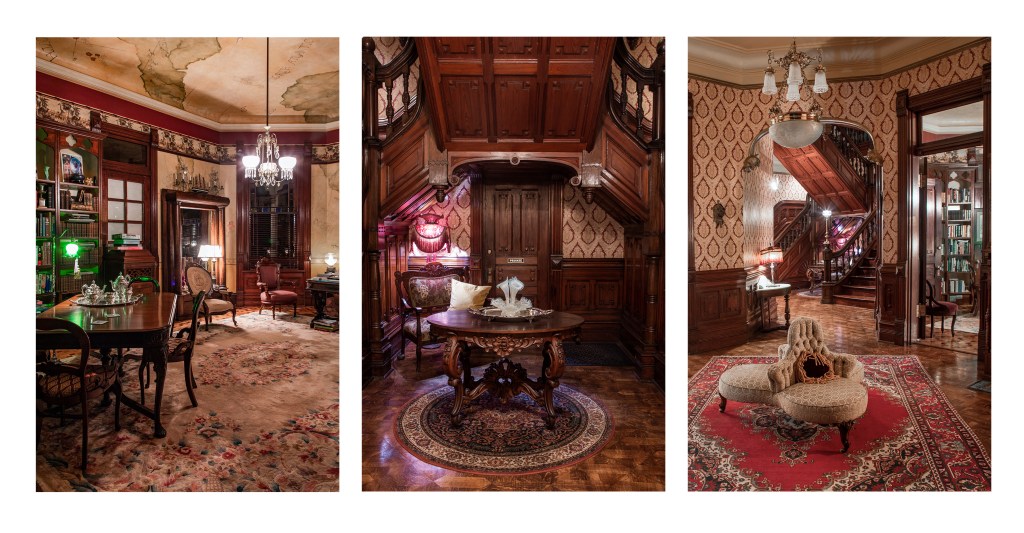
On the way home I spent the night in an impressive Victorian B&B in Little Rock.
The Empress of Little Rock
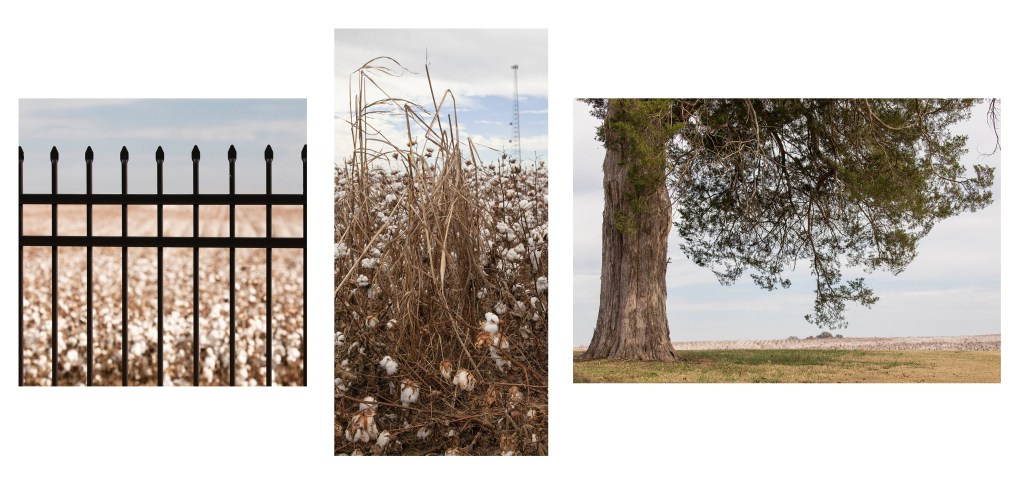
Then, when back in Tennessee, I stopped to photograph cotton fields:
Except for some brief interludes, I’ve always lived in the South. You’d think I’d tire of cotton fields, but I don’t. I still stop to photograph them. There is beauty and/or intrigue in everything; well, maybe not in the chiggers.
Spring is the season of re-birth, of new beginnings. And, so, equipped with a brand new “spring green” logo, I’m inviting you to take a peek at the newly refreshed website for Mary Rice Photography. You will find it at http://www.maryricephoto.com./
It seems there are often glitches in new websites, so I have a couple of favors to ask: 1) please give me some constructive feedback on the site, especially anything that’s not working; and 2) regardless of how the website appears, please spread the word that I’m open for business and welcome any and/or all of your referrals.
Why am I advertising Mary Rice Photography now? It comes down to this: I’m curious. I’ve never really marketed my photography skills to the general public (at least not in earnest) and I’m interested in learning what will come of it.
So now, borrowing the wonderfully descriptive words of Maya Angelou, “I’m a spring leaf trembling in anticipation.”
I really hope you visit my website, but I suspect some of you won’t, so here’s a little teaser with some of the new content:
This slideshow requires JavaScript.
What’s my niche? Probably at this point babies, headshots, and products. What do I want to develop? Pets, other lifestyle photography (especially seniors, couples and families), architecture, and assignment/editorial photography. I also want to create some collections of fine art photography.
I’ve set up a FB page for Mary Rice Photography. That’s where I plan to advertise promotions or specials and share some of my recent work and projects. You would just make my day if you got on FB, searched for Mary Rice Photography, and “like” it.
I’ll continue blogging on the same types of things here – thoughts and photographs on recent events, travels, and posts on photography related topics. All the while I’ll keep trying to figure out WordPress.
Anyway, thanks, as always, for following my blog AND a special thank you today, friends, for supporting Mary Rice Photography. Yes, “I get by with a little help from my friends.” — the Beatles
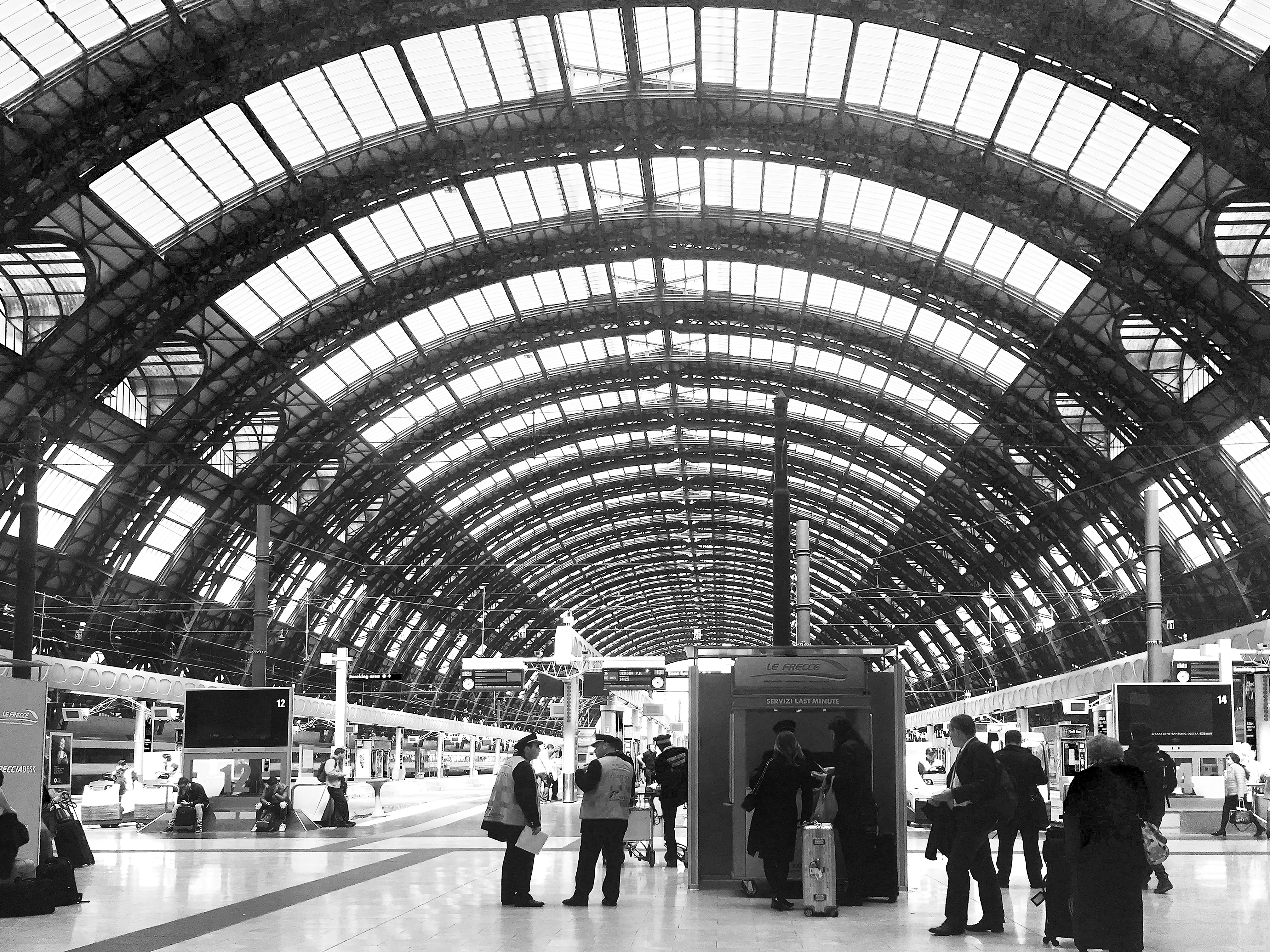
a big wide world with people coming and going and sharing different viewpoints and perspectives as captured on my cell phone
We all see life and life’s events unfold through a lens that’s unique to our own lives. It’s a lens that’s based on where we’ve lived, our past experiences, those with whom we interact, books we read, jobs we hold, faiths we practice, places we have traveled, etc. It’s a big wide world out there with many different angles, viewpoints and perspectives.
So maybe it’s not such a stretch to suggest that media organizations also see through a filtered lens or subscribe to particular viewpoints. I know traditionally trained journalists pride themselves on unbiased, objective reporting, yet it seems more and more the daily news (or at least the news that’s emphasized) varies significantly from one media source to another.
In the early days of cell phone cameras, I remember reading FB posts from some photojournalists saying how disappointing it would be if the major news organizations started relying on amateur photos and video from cell phone cameras instead of their own professional equipment and training. I’m not sure what these photojournalists would say today, but I do think American journalism is struggling, and cameras on cell phones have little to do with it. I think many Americans today first learn of news from questionable or unreliable sources.
But recently during this period of evolving journalism came one very loud and clear news story: a troubled teen armed with semi-automatic weapons killed 17 and injured many more at a Parkland, Florida high school. And how did this news first break? Through student cell phones, which included still and video camera footage. You know what? That camera footage didn’t present the situation with a slanted, biased, or unvetted viewpoint; it presented the situation just as it played out.
There’s a lot of talk about the harmful effects of too much cell phone usage and with much of that I agree; it’s just that at the same time, I think it’s possible that that “transparency” so often promised but unfulfilled by politicians, is also lacking in many of the current media outlets. You know where you can find transparency? In the stills and video on your phone.
I’ve thought about posting some of the Parkland students’ videos herebut have decided they might be too disturbing for my audience so I’m now turning to discuss another form of camera phone transparency. Please keep reading – I’m building to a point here.
A couple months ago a friend invited me to join her at a http://www.Photovoice.org workshop in London. Rather than paraphrasing what Photovoice is all about, here are some quotes from its website:
Photovoice’s vision is for a world in which everybody has the opportunity to represent themselves and tell their own story. We work across the world to build skills in underrepresented communities, using participatory photography and digital storytelling methods. We have worked in partnership in over thirty five countries in seventy-three different projects. Photography for social change.
A caveat at this point – Photovoice projects sometimes use DSLRs or point and shoot cameras, but nevertheless often rely on the simplest and most available cameras, which often are cell phone cameras.
In trying to gain a better understanding of Photovoice, I began reading some of the posts from those who have already put cameras in the hands of the marginalized. The posts which can be found on the website are powerful.
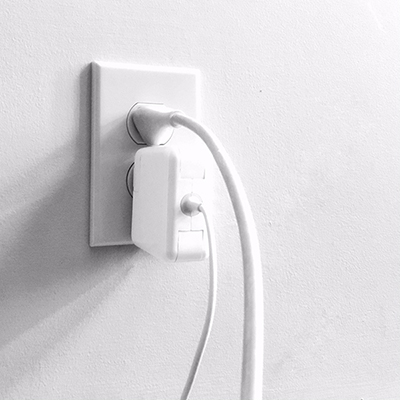
In one titled “Look Beyond – using Photovoice to break down barriers in mental health,” Dr. Maria Quinlan, a sociologist at the University College Dublin, asked a small group of students facing mental health challenges to tell their story – how they experienced life – by photographing their world. One student photographed an electrical socket with a cord plugged in on one side with the other side empty. His caption read: “Two sockets. One is connected, one disconnected. I have days when I’m connected to society and others where I’m totally detached. Lost, alone. I fight to stay connected, I want to, now stay connected. That is why the connected plug is first. This was not always the way.”
So what’s the point in all this?The point is that in an age when almost everyone carries a camera with them at all times, there is a greater transparency of what goes on in our world. So while politicians and perhaps the media often fall short on transparency, the news is there, often on our camera rolls. This constantly growing population of cell phone photographers supply us with the footage from school shootings, other people’s thought processes, and worlds we have never seen or experienced before.
Do I miss the days of the Walter Cronkite type journalism I felt I could trust? Yes. Do I miss mornings where I would search through TheTennessean newspaper for amazing photographs from veteran photojournalists? Absolutely. But am I also glad we now have an opportunity to see a broader, more transparent, more immediate view of the world as captured by a larger group of photographers? Yes.
I am glad both to have lived during the days when people read newspapers and watched the evening news, and to live today where so many have a camera in hand and capture a reality we otherwise might never have seen or understood. Cameras in the hands of just about everyone, not just a privileged few, provide an educational opportunity for us to discover worlds not previously seen or understood, and to act when we discover those in need or suffering injustice.
Thanks, as always, for following my blog. I won’t be attending a Photovoice workshop this spring, but I will be making an exciting announcement in the near future. I hope you’ll plug in.
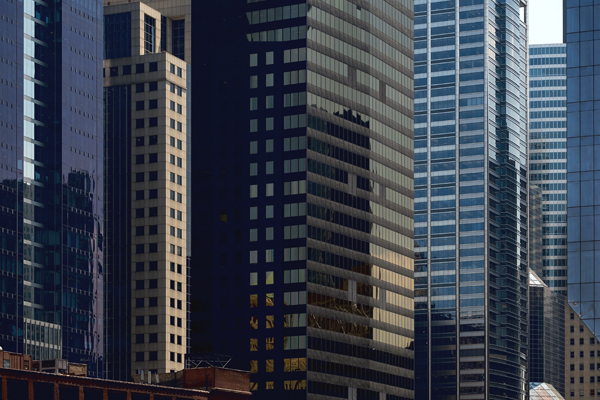
Most people know it as the Windy City. Sports fans walk around the streets in Cubs uniforms still relishing last year’s World Series win. Many in Nashville know Chicago as the closest city to see Hamilton. Politicians and the media seem only to talk about its high crime rate or financial troubles. But for just a few hours on Thursday afternoon, I saw it only as one big and vast visual playground.
Just after lunch my sister (Jody) and I boarded a two hour architectural boat tour. It was very hot — so hot that I remember wishing at the beginning of the tour that the boat could spend more time under the shaded bridges and less time in the bright sunlight. But by 3 pm we were both saying — “wow, that was the best boat tour we’ve ever been on” and “the architecture here really is just amazing.”
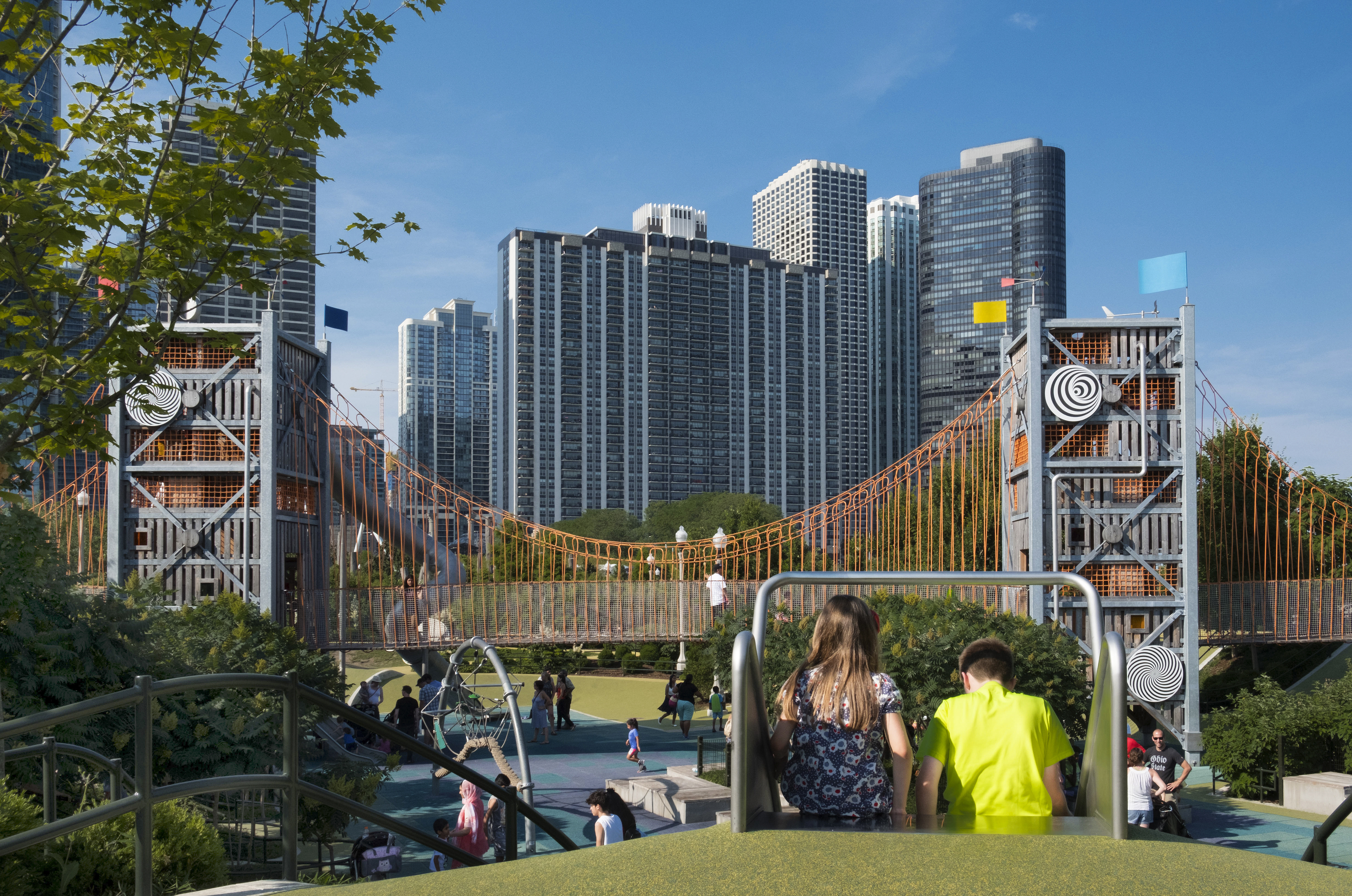
We had made dinner plans for 6:30 with a friend from my OGC days in Atlanta, so after a little scurrying around in our hotel room and bits of conversation of what we could squeeze in next, Jody decided she would attend one of the intro sessions of a conference she was attending and I decided to do a quick trip to Millennium Park and the new adjoining Maggie Daley Park. I had never been to Maggie Daley Park and they certainly weren’t ice skating in July, but there was still quite a lot of eye candy to take in.
Frank Lloyd Wright is credited with saying, “Eventually, I think Chicago will be the most beautiful great city left in the world.”
I really can’t agree or disagree with Frank Lloyd Wright’s sentiment, but I do think, based on my whirlwind exploration of Maggie Daley Park on Thursday, someone is trying very hard to preserve Chicago’s heritage of beautiful architecture and endless discovery, and I am thankful for that.
Architecture is art, it inspires, and it beckons us to explore, discover and to look up.








 Mary Rice's blog